Tiếng Việt
In the morning of Aug. 16, 2018, the ceremony event of “P2A – ASEAN In One 2018” is honored by the attendance and opening speeches by the Director of Community Affairs for ASEAN, Mr. Lee Yoong Yoong, the Director to the P2A Secretariat, Mr. Jeroen Schedler, the Standing Vice Secretary of the Da Nang Party Committee, Mr. Vo Cong Tri, and the President of Duy Tan University, Dr. Le Nguyen Bao, followed by a series of important activities given as below.

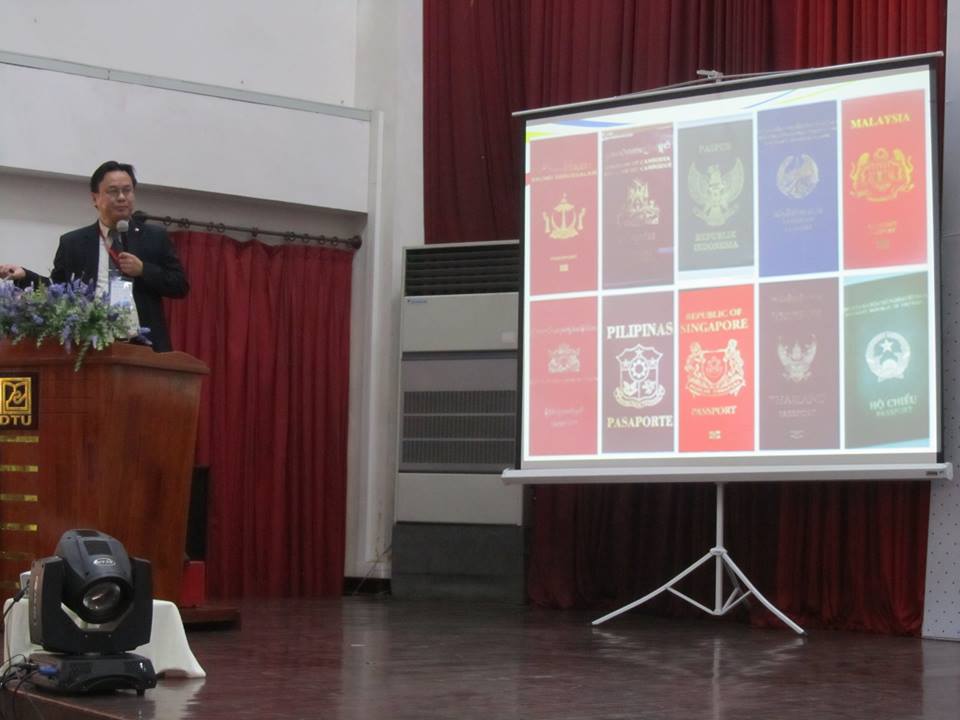
There are three speakers: Prof. Trung Q. Duong (Queen’s University Belfast, UK), Dr. Jolanda Tromp (Duy Tan University, Vietnam), and Dr. Anand Nayyar (Duy Tan University, Vietnam). Prof. Duong gives a talk about two Newton projects (Research Environment Link and Newton Prize) which are supported by the British Council. The first project is related to smart agriculture and the second project is to do with smart cities and disaster management. Both projects have a tight connection with smart cities and apply the advanced technologies like the Internet of Things (IoT) and Artificial Intelligence (AI) to the smart cities.
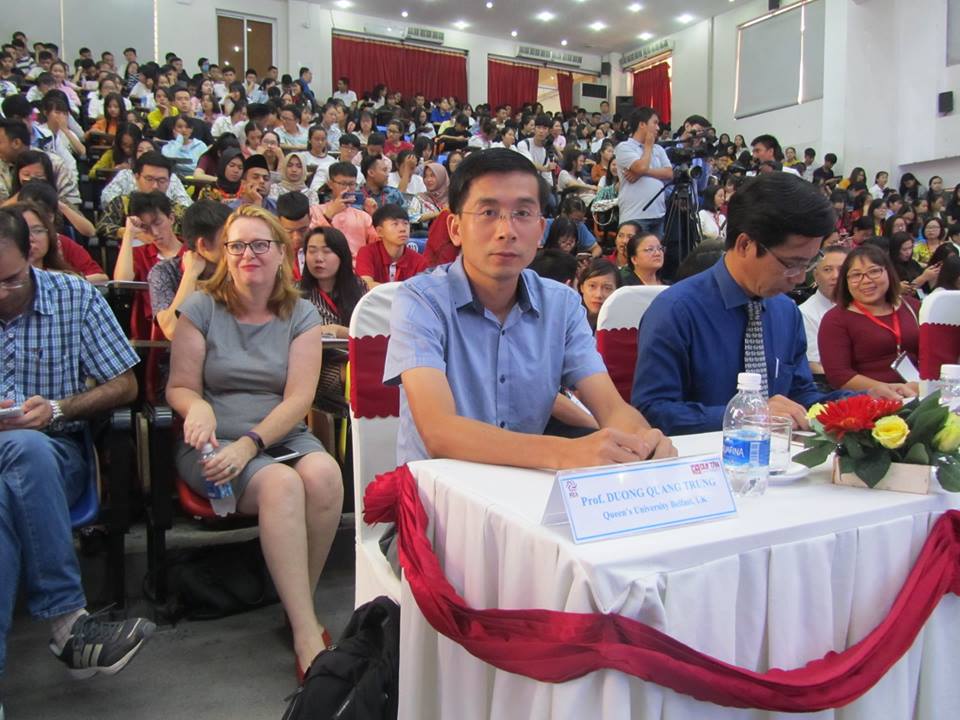
Prof. Duong then briefly introduces the basic background of Industry 4.0 (aka Industrial IoT or smart factory) and the basic concept of smart cities. Then Dr. Tromp presents the deep knowledge in Industry 4.0 and how the creative thinking can contribute to the development of this trend. In addition, the start-up company in the era of Industry 4.0 will also open a new door for youths in ASEAN countries. Dr. Nayyar discusses the smart cities, recent trends, and state-of-the-art technologies. Several domains of smart cities like smart living, smart environment, smart education etc are also addressed.
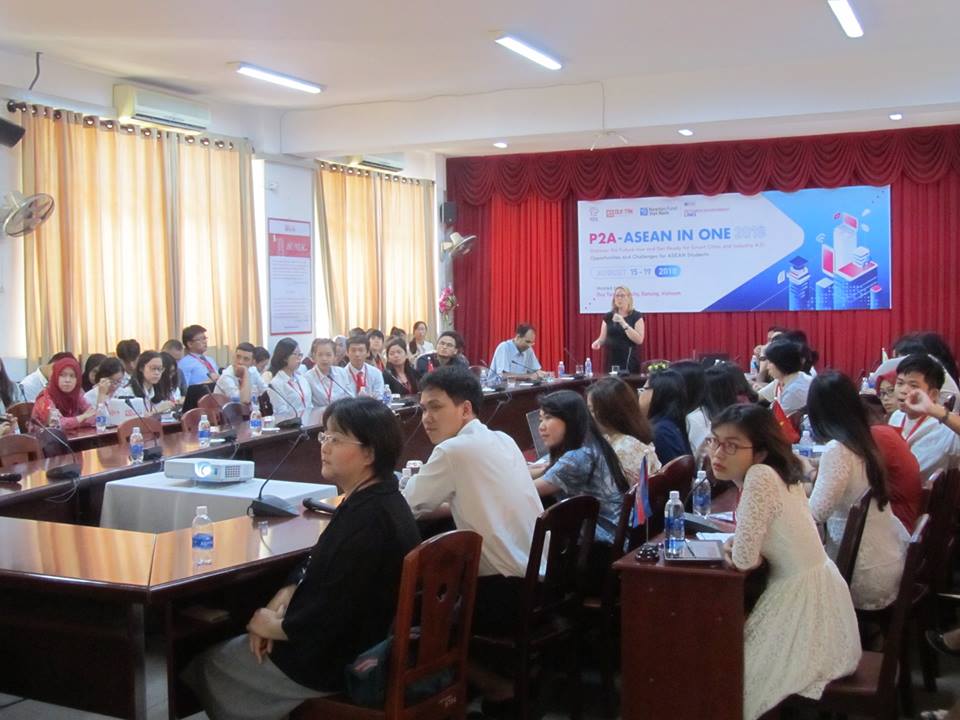
Finally, Prof. Duong delivers the most important talk in smart cities for ASEAN. While cities concentrate many societal and environmental problems, they also tend to be where solutions are forged. In the face of growing populations, resource constraints, and overburdened infrastructure systems, cities have to make better use of technology to do more with less. Prof. Duong points out that these have enormous potential for creating smart cities across ASEAN, where urbanisation is happening at a breakneck pace.
There are ten teams, representing 10 different ASEAN countries. The members of team are randomly selected and mixed in terms of nationality. Each team is assigned one country in ASEAN and they must select one city in the country for their project. The main purpose of the project is to identify the challenges of the city and propose few solutions for smart cities with the main purpose of improving the quality of life.
Each team is allowed to have 15 minutes to present their projects, and then followed by Q&A by the panels. Below are the instructions of the presentation:
Topic of ASEAN Youth Model Meeting
Smart cities are pop up in the world because of the impact of the industrial revolution 4.0. In your opinion, how should we build smart cities in ASEAN (pick one specific city in 10 ASEAN member countries)?
Scope of Topic:
- Smart Living: better access to city facilities and services like housing, utilities, etc. and thus improved quality of life
- Smart Mobility: Optimum movement of people, goods and information
- Smart Economy: Economic development, higher employment, higher investment
- Smart Governance: Stakeholder involvement in policy making and implementation, leveraging technology to facilitate the process, better transparency and accountability.
- Smart People: Better educational levels and skill building, health, lifelong learning and higher participation at community level
- Smart Environment: Sustainable development, natural resource utilization-optimal use of water resources and energy, balance between built and green areas
Instructions:
- One group (6-7 members) will pick one city among ASEAN countries to generate ideas how to build smart city in a city of selected country based on the given scope of topic.
- Each group will have 15-minute presentation.
It is exciting to see the strong engagement of all the teams. The ideas are fresh and sometimes they are too excited and surprised the panel in terms of the novelty. There are 1 or 2 teams not performing well in terms of the innovative proposals. These teams only provide general concept of smart cities and fail to provide good solutions. There is a mis-understanding between building a good infrastructure to create a better life in city and how to exploit the advanced technologies for the city. The latter is the main course of the smart cities. The panel carefully listen all the presentation and in the end of each talk, the panel provide insightful commend and fruit feedback. Each group learn from their pros and cons.
The panel use 5 criteria to judge the presentation including 1) Collaboration 2) Contribution 3) Time Management 4) Attendance 5) Presentation. All teams perform very well and clearly show their careful preparedness and good teamwork. The three best teams are selected. The 1st prize is team Philippine, the 2nd prize is team Indonesia and the 3rd prize is team Vietnam. The panel is really impressed by team Philippine by choosing the city Manila and propose the smart government and smart hospital. They even come up with a new idea for an app to avoid the waiting time in the hospital in Manila and also solving the problem of different types of patients waiting in the queue. The idea is extremely novel and can be applied to not only Manila but also many other big cities in ASEAN. Team Vietnam also has a good result by choosing Da Nang and suggests having several solutions for solving the natural hazard in this city. These projects use and collect data to monitor and predict potential risks, which informs urban planning as the city’s various agencies and entities partner to build more resilient housing units for low-income residents.
In summary, after a full day discussion between speakers and all the presentation from 10 teams, we conclude that there is no universal road map for cities to become “smarter.” ASEAN does not have to replicate a generic global template. Cities across the region can forge a new model that reflects their own challenges and priorities.
This “P2A – ASEAN In One 2018” is supported by a Research Environment Links grant, ID 339568416, under the Newton Programme Vietnam partnership. The grant is funded by the UK Department of Business, Energy and Industrial Strategy (BEIS) and delivered by the British Council. For further information, please visit www.newtonfund.ac.uk. This is also supported by the Newton Prize 2017 between QUB and DTU.
For more information about the P2A – ASEAN In One 2018, please visit the following links:
1) http://dantri.com.vn/khuyen-hoc/khai-mac-hoi-nghi-sinh-vien-asean-tai-da-nang-20180817083314794.htm
3) https://vtv.vn/hanh-trinh-den-asean.html